Table of Contents
- Starting your graphic design career
- Essential Steps for Professionals
- Key Numbers and Career Settings
- Achieving High-Quality Results
- Common Problems and Quick Fixes
- Legal and Industry Rules
- Long-term Professional Growth
- When to Use a Different Approach
- Frequently asked questions
- Can I become a designer without a degree?
- How long does it take to learn design?
- Is it safe to use free design assets?
- What happens if I get stuck on a project?
- How much do entry-level designers earn?
- Why is feedback important for designers?
- Conclusion
Choosing a career in visual communication offers high creative satisfaction and strong job security because graphic design is a rewarding profession driven by the constant demand for digital content across every industry. Most professionals earn a competitive salary while enjoying flexible work environments. This guide covers the essential skills, typical earnings, and growth paths for those entering the field.
Starting your graphic design career

Graphic design is the practice of using visual elements like typography, photography, and illustration to communicate ideas or messages. It’s used in everything from mobile app interfaces to product packaging and marketing materials. While many people think the job is just about making things look pretty, it’s actually about solving communication problems for businesses and users.
The field is for anyone who enjoys combining analytical thinking with artistic expression. A common misconception is that you must be a master of traditional drawing to succeed. In reality, modern design relies heavily on software proficiency and the way users interact with digital interfaces. According to the U.S. Bureau of Labor Statistics, designers work in various settings, including advertising agencies, design firms, and in-house corporate marketing departments.
Essential Steps for Professionals
- Learn the fundamentals of design theory, including color balance, grid systems, and typography, by taking a foundational course or following a structured curriculum.
- Download industry-standard software such as Adobe Creative Cloud; most beginners start by learning Photoshop and Illustrator for at least 10 to 15 hours per week.
- Build a portfolio featuring 5 to 8 high-quality projects that demonstrate your ability to solve specific client problems rather than just showing off artistic styles.
- Network with other designers through local meetups or industry organizations to gain feedback and learn about hidden job opportunities in your area.
- Apply for entry-level roles or internships, focusing on companies that provide mentorship, as early career guidance is vital for long-term development.
- Stay updated on emerging trends by reading reputable design journals or following updates from major software developers like Adobe.
Success often depends on your ability to accept critiques without taking them personally. If you can iterate on a design based on feedback, you’ll succeed; if you hold onto your initial ideas too tightly, you’ll struggle. Always remember that professional design requires specialized training or a degree; you can check specific educational requirements through the National Association of Schools of Art and Design.
Key Numbers and Career Settings
Designers work in diverse environments, each with its own pace and requirements for success, so identifying your preferred setting helps you focus your job search.
| Situation | What to use | How long | What to watch for |
|---|---|---|---|
| Advertising agency | Fast-paced software | 40-50 hours/week | Tight deadlines |
| In-house design | Brand guidelines | 35-40 hours/week | Company culture fit |
| Freelance work | Own equipment | Flexible schedule | Client communication |
| UI/UX design | Prototyping tools | 40 hours/week | User feedback loops |
| Print production | CMYK color profiles | Project-based | File specifications |
Achieving High-Quality Results
Experienced designers prioritize preparation before they ever open their design software. They start by sketching ideas on paper to explore multiple directions, which saves significant time during the digital phase. This process ensures they don’t get stuck in a single, ineffective layout.
They also check their work against accessibility standards throughout the process. This includes verifying that text contrast ratios meet the requirements set by the World Wide Web Consortium. Beginners often skip this step and have to redo their work later. Experienced designers also know when to stop; they understand that over-polishing a design can sometimes remove the impact and clarity of the original message.
Common Problems and Quick Fixes
| What you notice | What it usually means | What to do first |
|---|---|---|
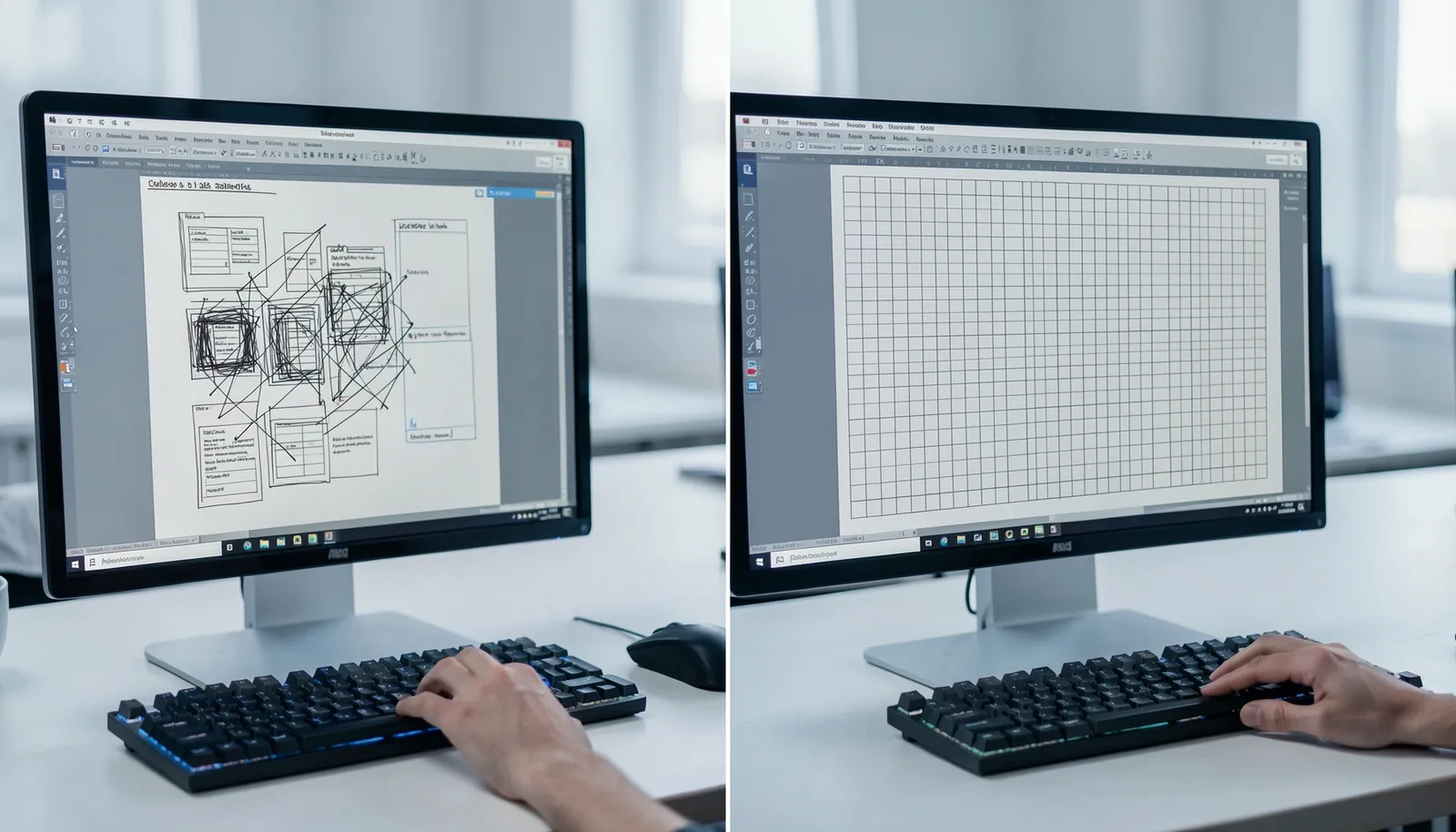
| Design looks messy | Lack of alignment | Apply a strict grid |
| Colors look dull | Wrong color mode | Switch to RGB mode |
| Text is hard to read | Poor contrast | Increase font weight |
| File is too large | Image resolution | Optimize file export |
When your grid feels restrictive, check your margins. If elements still drift, you’re likely missing a baseline lock. Snap every object to the nearest pixel to eliminate blurry edges.
Dull colors often stem from a CMYK color profile used on digital screens. If your project is strictly for web viewing, ensure your workspace is set to sRGB. This prevents the color shift that happens during export.
Legibility issues often hide in the line height. If increasing font weight fails, expand your leading by 20 percent. This creates white space that allows the eye to track lines without fatigue.
Large files are usually caused by embedded metadata or uncompressed layers. If you see a file size over 5MB, flatten your hidden layers before saving. This simple step often cuts your export size in half.
Legal and Industry Rules
Professional designers must respect intellectual property laws and copyright regulations. Using unlicensed assets can lead to significant legal issues for both the designer and their clients. You must ensure that every font, photograph, and icon you use has the correct licensing for commercial work.
Additionally, designers often work under non-disclosure agreements when handling sensitive corporate information. If you aren’t sure about a specific legal requirement, consult your local labor department or a professional legal advisor. Never use assets from the internet without verifying the license, as this can result in heavy fines or a loss of professional reputation.
Long-term Professional Growth
Maintaining a career in this field requires constant learning. Software updates occur frequently, and design trends shift every few years. You should set aside time each month to experiment with new tools or techniques. Keep your portfolio updated with your most recent and relevant work to show how your skills have evolved.
If you find that your design speed is slowing down, it’s usually a sign that you need to master new keyboard shortcuts or update your software plugins. Most designers find that refreshing their skills every 6 to 12 months keeps them competitive in the job market.
When to Use a Different Approach

This career path isn’t for everyone, especially those who prefer strictly repetitive tasks or dislike constant feedback. If you find that you don’t enjoy the creative process after a few months, consider pivoting to a related field like project management or data analysis. Designers who find the creative process stressful often thrive in these roles because they already understand the visual workflow. If you prefer high-level strategy over hands-on creation, look into creative direction or art management roles instead.
Related guides
Frequently asked questions
Can I become a designer without a degree?
Yes, many designers enter the field with a strong portfolio instead of a degree. You must prove your skills through high-quality projects, as employers prioritize your ability to solve visual problems over academic credentials.
How long does it take to learn design?
It takes 6 to 12 months of consistent study to become job-ready for entry-level roles. This assumes you spend at least 15 hours per week practicing software and learning design theory.
Is it safe to use free design assets?
No, you must always check the specific license for every asset. Many free items are only for personal use; using them for commercial projects without a proper license can lead to copyright claims.
What happens if I get stuck on a project?
You should step away from the screen for at least 30 minutes to clear your head. If you remain stuck, look for inspiration in design archives or ask a peer for a critique to gain a fresh perspective.
How much do entry-level designers earn?
Earnings vary by region and company size, but entry-level positions are generally affordable to start in compared to other creative fields. You can check the specific salary data for your city on official government labor websites.
Why is feedback important for designers?
Feedback helps you identify blind spots in your work that you can’t see yourself. If you ignore critique, your designs will likely fail to meet the needs of the target audience or client.
Conclusion
Building a successful career in this field takes time, but it’s a deeply fulfilling path for anyone who loves visual storytelling. You shouldn’t wait to start crafting your portfolio, as it’s the best way to showcase your unique voice. Grab your favorite design tools today and begin creating projects that truly excite you.